Indium/Silver Alloy Spooled Wire (In97/Ag 3) Description
Indium/Silver Alloy Spooled Wire
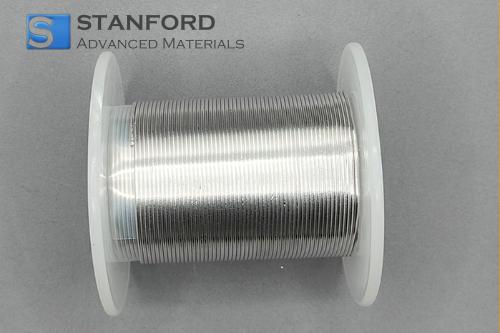
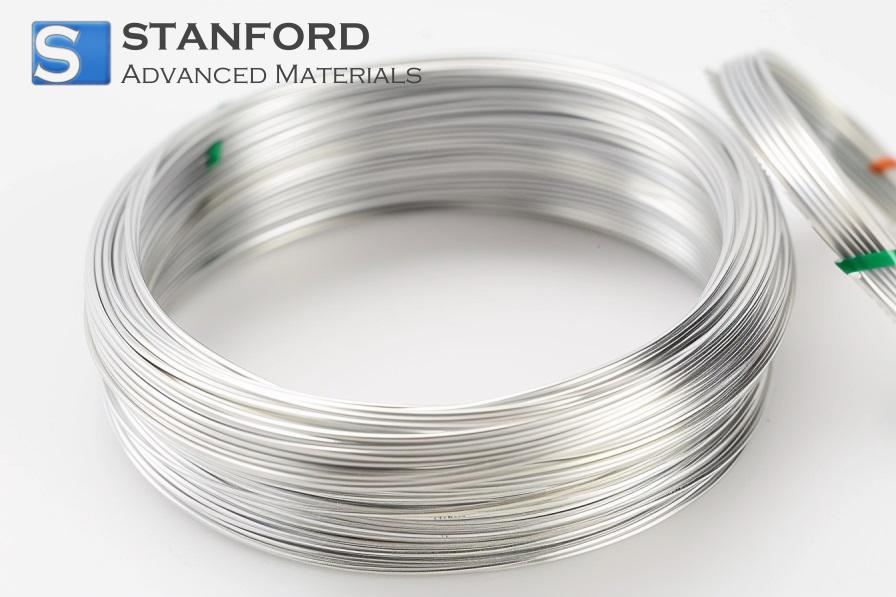
(In97/Ag3) is a eutectic alloy composed of 97% indium and 3% silver by weight.
Its eutectic nature ensures a single melting point at 143°C, eliminating the
plastic range between solidus and liquidus temperatures. This allows rapid
solidification and precise bonding in applications requiring minimal thermal
stress. This alloy exhibits excellent ductility and high thermal conductivity,
making it suitable for low-temperature soldering processes, particularly in
cryogenic environments and precision electronics assembly.
The material demonstrates
outstanding oxidation resistance due to indium's inherent stability, ensuring
reliable bonding even in sensitive applications like aerospace and
photovoltaics. Its low electrical resistivity enhances performance in
electrical interconnects, while adding silver improves mechanical strength
without compromising flexibility. The alloy is supplied in spooled form,
facilitating both automated and manual soldering workflows.
Environmentally, it is classified
under WGK 3 (moderately hazardous to water) and stored as non-combustible
solids (Storage Class Code 13). Its compliance with RoHS standards further
supports its use in eco-sensitive industries. The combination of low melting
temperature, thermal stability, and corrosion resistance positions In97/Ag3 as
a critical material in semiconductor packaging, optoelectronics, and advanced
metallurgical applications.
Indium/Silver Alloy Spooled Wire (In97/Ag 3) Applications
1. Low-Temperature Soldering: Ideal for heat-sensitive
components in electronics (e.g., LEDs, MEMS devices) and cryogenic systems
(superconducting circuits), as its 143°C melting point minimizes thermal
damage.
2. Semiconductor Packaging: Used for die attachment in power
electronics and optoelectronic modules, ensuring reliable thermal and
electrical conductivity in high-performance chips.
3. Aerospace & Defense: Bonds components in satellites
and avionics, where extreme thermal cycling and vacuum environments demand
oxidation-resistant, fatigue-resistant joints.
4. Photovoltaics: Connects solar cell interconnects with
minimal stress, enhancing durability under temperature fluctuations.
5. Medical Devices: Employed in hermetic sealing of
implantable sensors or MRI equipment, leveraging biocompatibility and
low-temperature processing.
6. Thermal Interface Materials (TIMs): Creates efficient
heat-transfer layers in CPUs, GPUs, and power modules, exploiting its high
thermal conductivity.
7. Flexible Electronics: Bonds thin-film circuits in
wearable tech, benefiting from the alloy’s ductility and low creep resistance.
Indium/Silver Alloy Spooled Wire (In97/Ag 3) Packaging
Our products are packaged in customized cartons of various
sizes based on the material dimensions. Small items are securely packed in PP
boxes, while larger items are placed in custom wooden crates. We ensure strict
adherence to packaging customization and the use of appropriate cushioning
materials to provide optimal protection during transportation.
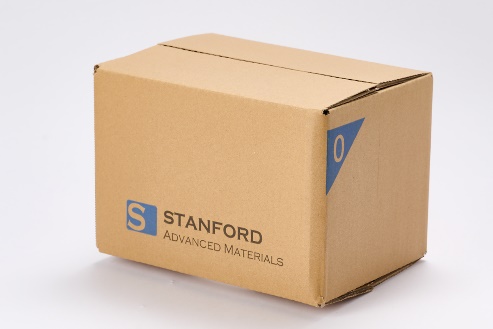
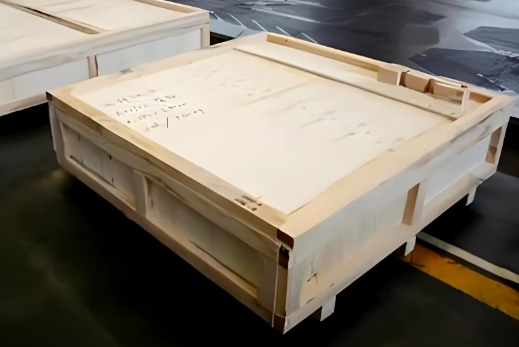
Packaging: Carton, Wooden Box, or Customized.
Kindly review the packaging
details provided for your reference.
Manufacturing Process
1. Testing Method
(1) Chemical Composition Analysis - Verified using techniques
such as GDMS or XRF to ensure compliance with purity requirements.
(2) Mechanical Properties Testing - Includes tensile strength,
yield strength, and elongation tests to assess material performance.
(3) Dimensional Inspection - Measures thickness, width, and
length to ensure adherence to specified tolerances.
(4) Surface Quality Inspection - Checks for defects such as
scratches, cracks, or inclusions through visual and ultrasonic examination.
(5) Hardness Testing - Determines material hardness to confirm
uniformity and mechanical reliability.
Please refer to the SAM testing procedures for detailed information.
Indium/Silver Alloy Spooled Wire (In97/Ag 3) FAQs
Q1. What are the key properties of In97/Ag3 alloy?
The alloy features a low eutectic melting point (143°C),
high thermal/electrical conductivity, excellent ductility, oxidation
resistance, and fatigue resistance. Its single-phase solidification ensures
precise bonding with minimal thermal stress.
Q2. Why is it suitable for low-temperature soldering?
Its 143°C melting point prevents damage to heat-sensitive
components (e.g., LEDs, semiconductors), making it ideal for cryogenic systems,
medical devices, and flexible electronics.
Q3. How does it perform in extreme environments?
The alloy resists oxidation and thermal fatigue, excelling
in aerospace (satellites, avionics), photovoltaics (solar cells), and
high-vacuum applications.
|
Property/Product
|
In97/Ag3 (Indalloy 290)
|
90In10Ag (Indalloy 3)
|
Sn96.5/Ag3.0/Cu0.5 (SAC305)
|
Sn63/Pb37 (Traditional Solder)
|
Sn/Ag High-Temp Alloy
|
|
Composition
|
97% In, 3% Ag
|
90% In, 10% Ag
|
96.5% Sn, 3% Ag, 0.5% Cu
|
63% Sn, 37% Pb
|
Varies (e.g., Sn95/Sb5)
|
|
Melting Point
|
143°C (eutectic)
|
143–237°C (plastic range)
|
217–220°C
|
183°C (eutectic)
|
232–260°C
|
|
Electrical Conductivity
|
High (low resistivity)
|
Moderate
|
Moderate
|
Moderate
|
Low
|
|
Thermal Conductivity
|
High
|
Moderate
|
Moderate
|
Low
|
Low
|
|
Mechanical Strength
|
Moderate (ductile)
|
Low (ductile, large plastic range)
|
High (rigid)
|
Low (ductile)
|
High (rigid)
|
|
Ductility
|
Excellent
|
Good
|
Low
|
Excellent
|
Low
|
|
Oxidation Resistance
|
Excellent (In stability)
|
Good
|
Moderate
|
Poor
|
Moderate
|
|
Key Advantages
|
Low thermal stress, cryogenic use
|
Flexible in the plastic range
|
Cost-effective, standard use
|
Low melting point, legacy use
|
High-temperature stability
|
|
Typical Applications
|
Aerospace, medical devices, photovoltaics
|
Low-temp bonding, flexible circuits
|
Consumer electronics, PCB assembly
|
Legacy electronics (phased out)
|
Automotive, power modules
|
Related Information
1. Common Preparation Methods
The fabrication of advanced
materials and alloys involves a range of specialized techniques tailored to optimize
performance for specific applications. Key processes include powder metallurgy
sintering, where metal or alloy powders, produced via atomization, reduction,
or electrolysis, are compacted under high pressure and sintered below their
melting points. Methods like spark plasma sintering (SPS) enable rapid heating
(e.g., 1963K for TiN ceramics) to achieve nanostructured materials with minimal
grain growth, while liquid-phase sintering leverages transient molten phases to
enhance densification. Atmosphere control during sintering (using hydrogen,
argon, or vacuum) prevents oxidation and ensures material integrity.
For soldering applications,
eutectic alloys such as In97/Ag3 (melting at 143°C) are critical for
low-temperature bonding in electronics and cryogenic systems, offering minimal
thermal stress. Non-eutectic alloys like In90/Ag10 provide a plastic
temperature range (143–237°C), accommodating flexible circuit assembly.
High-temperature solders, such as SAC305 (Sn/Ag/Cu), are processed via vacuum melting
and controlled cooling for automotive or aerospace use.
Surface treatments like indium
electroplating employ sulfamate baths (pH 1.8–2.0, 20–30°C) with amine
additives to deposit smooth, corrosion-resistant coatings, achieving over 80%
cathode efficiency. Chemical nickel plating relies on precise thermal
management to stabilize the bath and avoid decomposition.
Welding techniques are equally
specialized. TIG welding uses non-consumable tungsten electrodes under argon
shielding for thin, oxidation-sensitive components, while MIG welding employs
consumable wire electrodes (e.g., Al-Si alloys) with Ar/CO₂ gas for thicker
plates, enabling high-speed spray transfer modes.
Advanced processing methods include
gradient material fabrication via SPS with temperature-controlled molds (e.g.,
stainless steel/ZrO₂ composites) and non-consumable electrode melting for
high-purity semiconductors like InAs/AlSb heterostructures. Heat treatments
such as quenching, tempering, or nitriding (e.g., 38CrMoAlA steel) enhance mechanical
properties like hardness (45–52 HRC) and wear resistance
Additive manufacturing techniques,
including binder jetting and selective laser sintering, enable 3D-printed metal
composites, often followed by hot isostatic pressing (HIP) for densification.
Meanwhile, sputtering targets for solar cells are produced through
inert-atmosphere melting and rapid solidification to ensure compositional
homogeneity.
These processes collectively
address demands across aerospace, electronics, renewable energy, and biomedical
sectors, emphasizing precision, efficiency, and adaptability to emerging
material challenges.
 English (US)
 English (UK)
 Española
 Deutsch
 Français
 Italiano
 日本語
日本語 Русский
 한국어
한국어 Português
 العربية

 Products
 Bars
Bars
 Beads & Spheres
 Bolts & Nuts
 Crucibles
 Discs
Discs
 Fibers & Fabrics
 Films
Films
 Flake
Flake
 Foams
Foams
 Foil
Foil
 Granules
 Honeycombs
 Ink
Ink
 Laminate
 Lumps
Lumps
 Meshes
 Metallised Film
 Plate
Plate
 Powders
 Rod
Rod
 Sheets
 Single Crystals
 Sputtering Target
 Tubes
Tubes
 Washer
 Wires
Wires
 Converters & Calculators
 Write for Us