
 Products
 Bars
Bars
 Beads & Spheres
 Bolts & Nuts
 Crucibles
 Discs
Discs
 Fibers & Fabrics
 Films
Films
 Flake
Flake
 Foams
Foams
 Foil
Foil
 Granules
 Honeycombs
 Ink
Ink
 Laminate
 Lumps
Lumps
 Meshes
 Metallised Film
 Plate
Plate
 Powders
 Rod
Rod
 Sheets
 Single Crystals
 Sputtering Target
 Tubes
Tubes
 Washer
 Wires
Wires
 Converters & Calculators
 Write for Us



Top Applications of Shape Memory Alloys
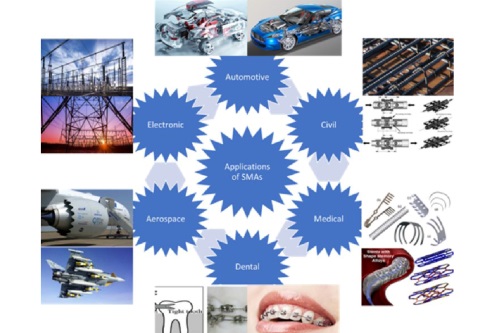
Shape Memory Alloys (SMAs) are a unique class of smart materials capable of returning to a pre-defined shape when exposed to a specific thermal or mechanical stimulus. Unlike conventional metals, SMAs exhibit shape memory effect and superelasticity, enabling them to respond dynamically to their environment. Among them, Nitinol (nickel–titanium alloy) is the most widely used, but copper-based and iron-based SMAs also play important roles in engineering. Thanks to their ability to combine sensing, actuation, and structural functions into a single material, SMAs are now widely used across medical, industrial, aerospace, robotics, and consumer applications.
 [1]
[1]
Medical Devices – the most mature and high-value application
The medical technology sector is the most established and regulated for SMAs. They are bio-compatible, lend themselves to flexibility, and possess considerable fatigue resistance.
SMAs are also commonly used in vascular stents, guidewires, orthopedic implants, orthodontic archwires, and various surgical devices. Superelastic SMA has the ability to undergo large strains as the device fits into the body by compressing the wires. This feature greatly alleviates tissue damage.
Besides that, the SMA can also be harnessed to allow temperature-activated deployment, which is extremely valuable in self-expanding stents and fixation devices. Durability, resistance to corrosion, and compatibility with imaging technologies, such as MRI, also add to the unparalleled use and superiority of SMAs in this field.
Related reading: Top 6 Medical Applications of Nitinol
Actuators – compact alternatives to motors and hydraulics
SMA actuators find great applications wherever space constraints, noise requirements, and high force density need to be met. Here, the SMA actuators differ from other conventional actuators because they do not need mechanical gears and motors to convert thermal energy.
They can be generally found in industrial automation, aerospace technology, consumer electronics, and various automotive parts. As mentioned, various examples include thermal valves, adaptive vents, latching systems, and micro-positioning technologies. As SMAs have the ability for both sensing and actuation, it is clear that complexity is kept at a minimum.
While the operating speed tends to be slower for SMA actuators in comparison to electromagnetic actuators, their ease of use and reliability make them suitable for situations that demand moderate cycling.
Aerospace – weight reduction and adaptive structures
In aerospace engineering, every gram counts, and this is one field where SMAs are being used more and more to provide flexible, light, and maintenance-free devices, whether on aircraft or spacecraft.
Typical applications consist of wing parts, vibration damping, thermal release, and space structures. In these applications, it acts as a substitute for complex mechanical systems with minimal parts, especially for environments that contain extreme temperatures and pressures.
Ability to function in a vacuum, perform under radiation exposure, and operate across a broad range of temperatures makes these devices highly suitable for satellite and space exploration technologies.
Robotics – enabling soft and biomimetic motion
SMAs have great application in the development of soft robotics and biomimetic devices, as in such systems, rigid actuators cannot be used.
With their muscle-contractile behavior, wires and springs in SMA enable organic movements in robotic grippers, artificial limbs, and wearable exoskeletons. Their quiet working nature and miniature size make them suitable for use in human-interacting environments.
In medical robotic and rehabilitation systems, SMAs facilitate soft force application and response. Hence, it enhances not only safety and comfort but also grows robotics using these materials.
Automotive Systems – reliability and thermal responsiveness
The automotive industry employs SMAs to enable thermally responsive and self-regulating components to ensure reliability and mechanical simplicity.
The most common applications include engine thermal control valves, adaptive airflow, safety, as well as comfort features such as adjustable seats and ventilation. The SMAs are appreciated due to their durability during usage as well as their capacity to function without further devices, such as sensors, in some instances.
Resistance to vibration and adverse conditions ensures their viability for automotive applications, especially for hybrid and electric vehicles, where energy efficiency is extremely important.
Civil Engineering – self-adaptive and seismic-resistant structures
For instance, in civil infrastructure, SMAs find application in ensuring better structural resilience in places prone to earthquakes.
SMA-based dampers, reinforcements, and connectors have the ability to absorb seismic forces during earthquakes. The structure also returns to its original position after the earthquakes. Therefore, there are no reconstruction costs.
Bridges, high-rise buildings, and retrofitted historical buildings undergo significant benefits with SMA materials that have sufficient strength, flexibility, and durability without maintenance difficulties.
Consumer Electronics – miniaturization and smart functions
In compact consumer devices, SMAs offer elegant solutions in miniaturized motion and precision control.
These devices may also be part of camera autofocus systems or optical image stabilization modules, haptic feedback systems, and smart wearables. The SMA devices generally provide a noise-free and space-saving advantage compared to conventional motor devices.
As interest increases for more intelligent and responsive electronic devices, SMAs will continue to assist advancements in their form and function.
Oil, Gas, and Energy – durability in harsh environments
SMAs are also employed in oil, gas, and energy systems where components must operate reliably under extreme pressure, temperature, and corrosion.
Applications include self-actuating valves, pipeline couplings, safety release mechanisms, and downhole tools. The ability of SMAs to function without external power or complex control systems is especially valuable in remote or inaccessible environments.
Their corrosion resistance and fatigue performance contribute to reduced maintenance and improved operational safety.
Table 1: Characteristics of Shape Memory Alloys Used Across Applications
Application Area | Key SMA Property Utilized | Typical Benefits |
Medical devices | Superelasticity, biocompatibility | Minimally invasive design, patient safety |
Actuators | Shape memory effect, high force density | Compact, silent motion |
Aerospace | Thermal stability, low weight | Reliability, adaptive structures |
Robotics | Muscle-like contraction | Smooth, biomimetic movement |
Automotive | Thermal responsiveness | Reduced complexity, durability |
Civil engineering | Energy dissipation, self-centering | Seismic resistance |
Consumer electronics | Miniaturization | Slim design, precision control |
Energy & oil | Corrosion resistance | Long service life |
Conclusion
Shape Memory Alloys bridge the gap between materials and machines. By combining structural integrity with intelligent response, they enable simpler designs, improved reliability, and new functional possibilities across industries. As material processing, control strategies, and application experience continue to evolve, SMAs are set to play an even greater role in shaping the future of smart engineering systems. For more advanced materials, please check Stanford Advanced Materials (SAM).
Reference:
[1] Raza, Syed & Khan, Imran & Ahmad, Mairaj & Tahir, Danish & Iltaf, Asim & Naqvi, Rida. (2021). Effect of Nano-Silica Volume Reinforcement on the Microstructure, Mechanical, Phase Distribution and Electrochemical Behavior of Pre-Alloyed Titanium-Nickel (Ti-Ni) Powder. Key Engineering Materials. 875. 60-69.
 Dr. Samuel R. Matthews