
 Products
 Bars
Bars
 Beads & Spheres
 Bolts & Nuts
 Crucibles
 Discs
Discs
 Fibers & Fabrics
 Films
Films
 Flake
Flake
 Foams
Foams
 Foil
Foil
 Granules
 Honeycombs
 Ink
Ink
 Laminate
 Lumps
Lumps
 Meshes
 Metallised Film
 Plate
Plate
 Powders
 Rod
Rod
 Sheets
 Single Crystals
 Sputtering Target
 Tubes
Tubes
 Washer
 Wires
Wires
 Converters & Calculators
 Write for Us



6 Great Women in Science and Technology
Every year on February 11, the world marks the International Day of Women and Girls in Science—a moment to celebrate achievement, reflect on progress, and, just as importantly, acknowledge how much more there is to do. It is a day that invites us to look beyond statistics and remember the stories: the curiosity sparked in childhood, the persistence in the face of closed doors, and the quiet determination that led to discoveries changing how we understand the world.
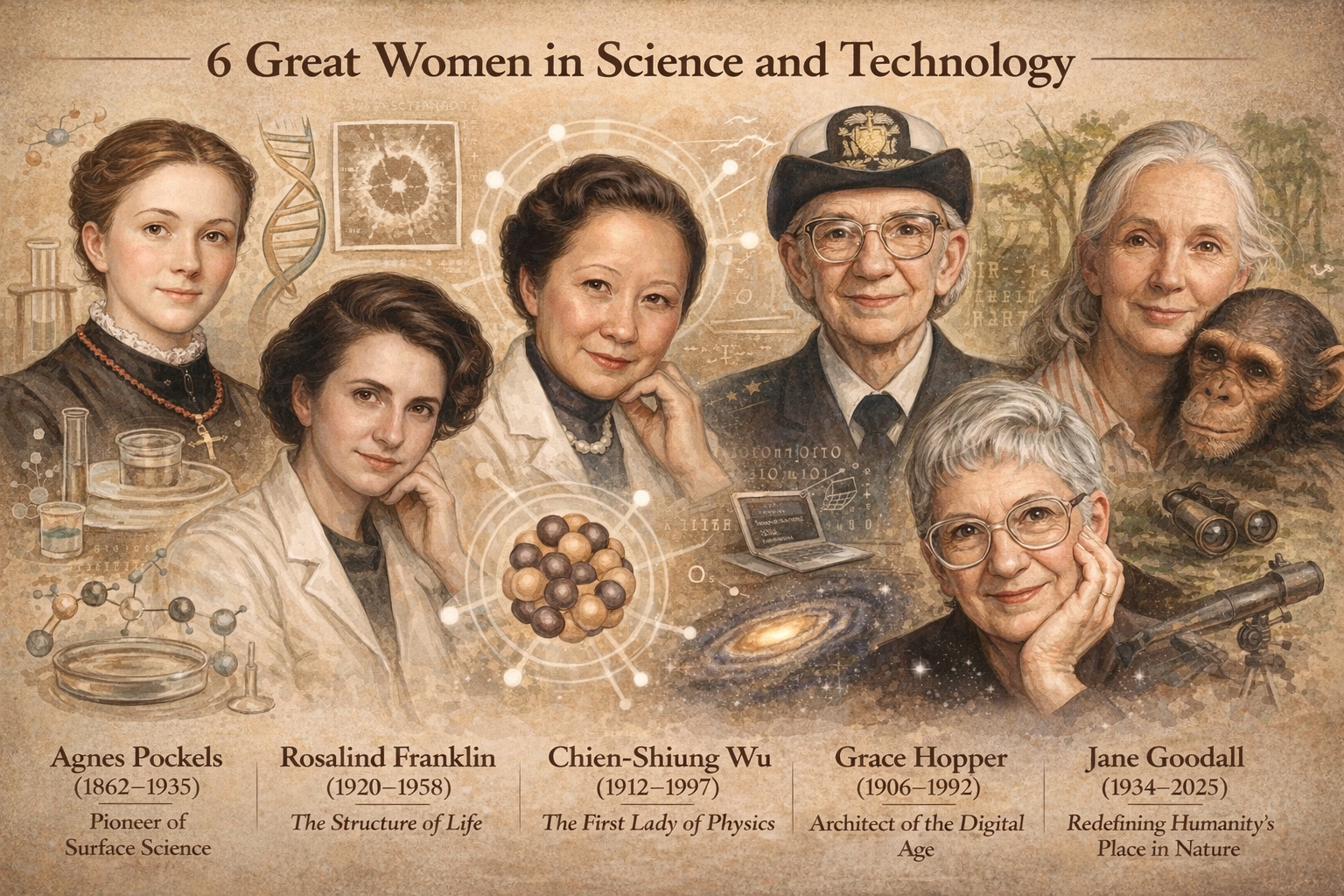
1. Agnes Pockels (1862–1935) – Pioneer of Surface Science
Agnes Pockels never held a formal academic position, yet she laid the foundations of modern surface chemistry. Unable to attend university, she educated herself through scientific papers borrowed by her brother. While carrying out household chores and caring for her parents, she made a simple but profound observation: oils and soaps dramatically altered the behavior of water.
From this insight, Pockels devised an apparatus to measure surface tension—what we now recognize as a cornerstone of colloid and interface science. With encouragement from Lord Rayleigh, she published her findings in Nature in 1891. Her work went on to influence fields ranging from detergents to materials science. From washing dishes to founding a scientific discipline, her story remains one of the most inspiring in science.
2. Rosalind Franklin (1920–1958) – The Structure of Life
Few scientific tales are as fascinating as that of Rosalind Franklin. She was an exceptionally talented scientist with expertise in X-ray crystallography. Her work led to one of the most significant discoveries in life science—the double helix structure of DNA. She was an expert in the subject matter that led her to carry out her work with precision.
Nevertheless, during her lifetime, her contribution had not received the recognition it deserved. It is only later on that the entire scientific community realized the scope of her contribution. Apart from her DNA structure contribution, Franklin made other groundbreaking achievements, particularly in the field of viruses and carbon materials. In fact, her legacy cannot lie outside the realm of culture.
3. Chien-Shiung Wu (1912–1997) – The First Lady of Physics
One of the most formidable experimenters of the 20th century is Chien-Shiung Wu, who is known for her most famous work: the Wu experiment that showed us that the rule of parity conservation does not always apply in weak nuclear reactions.
If it had not been for the experimental skill of Wu, the theoretical physicists would not have been honored with the Nobel Prize. Apart from this outstanding contribution, Wu made important contributions to nuclear physics and beta decay. Her contributions demonstrate exceptional scientific skill, as well as women's under-recognition in science.
4. Grace Hopper (1906–1992) – Architect of the Digital Age
Grace Hopper was a person who connected math, engineering, and computer science during an era when computer systems were housed in rooms the size of a basketball gymnasium. A Rear Admiral in the U.S. Navy and a pioneering computer programmer, Hopper was a principal contributor to the invention of the first compiler - a term that allows people to program computers.
Hopper was also instrumental in developing COBOL, a computer language that dominated business and government computing for decades. Her advocacy that computers should adapt to humans, not vice versa, contributed to the development of modern software design tools. Today, computers have fingerprints of this prolific programmer everywhere.
5. Jane Goodall (1934–2025) – Redefining Humanity's Place in Nature
Jane Goodall has significantly changed the way humans view the behavior of animals through her research of chimpanzees in Tanzania. She did not need to undergo special laboratory training to observe the behavior of the primates.
Her findings were a challenge to the conventional views on what differentiated human beings from animals. Her studies have also significantly affected the study of primates. In addition to the scientific impact, Goodall is now a worldwide champion for conservation, education, and sustainability, demonstrating the power of science to motivate altruism.
6. Vera Rubin (1928–2016) – Revealing the Invisible Universe
Vera Rubin's work changed cosmology forever. By analyzing the rotation patterns of galaxies, Rubin supplied the strongest evidence for dark matter, a mysterious substance that forms much of the mass in the cosmos.
While women were not allowed to use telescopes as astronomers, Vera continued her work. Vera's discoveries changed the way scientists thought about the universe. Today, the presence of dark matter is the core of modern astrophysics, and Vera's life among the stars is not forgotten.
Final Thoughts
These six women represent only a fraction of the talent, dedication, and brilliance women have brought to science and technology. There are many more—past and present—whose names could easily fill volumes. The limits of length, not importance, determine who appears here.
The International Day of Women and Girls in Science reminds us that science has no boundaries of gender, discipline, or background. It thrives on curiosity, rigor, and imagination. As barriers continue to fall, the future of science will be richer, more inclusive, and more innovative because of the women and girls who choose to pursue it.
The Journey of Women Scientists at SAM
At Stanford Advanced Materials (SAM), our commitment to talent and culture reflects the spirit of this global day.
- We partner with schools and universities to inspire girls in STEM through workshops, mentorship programs, and STEM outreach events.
- SAM fosters inclusive R&D teams where women in technical roles are supported to lead projects, publish research, and mentor others.
- We regularly spotlight women's achievements in materials innovation — from ceramic membranes to alloy design — celebrating both foundational science and commercial impact.
As SAM advances materials science and solutions for global challenges, women scientists and engineers remain indispensable drivers of progress.
 Dr. Samuel R. Matthews