
 Products
 Bars
Bars
 Beads & Spheres
 Bolts & Nuts
 Crucibles
 Discs
Discs
 Fibers & Fabrics
 Films
Films
 Flake
Flake
 Foams
Foams
 Foil
Foil
 Granules
 Honeycombs
 Ink
Ink
 Laminate
 Lumps
Lumps
 Meshes
 Metallised Film
 Plate
Plate
 Powders
 Rod
Rod
 Sheets
 Single Crystals
 Sputtering Target
 Tubes
Tubes
 Washer
 Wires
Wires
 Converters & Calculators
 Write for Us



Promethium: Element Properties and Uses
Promethium is a rare radioactive lanthanide element with distinct chemical and physical properties, widely used in nuclear batteries and luminous devices.
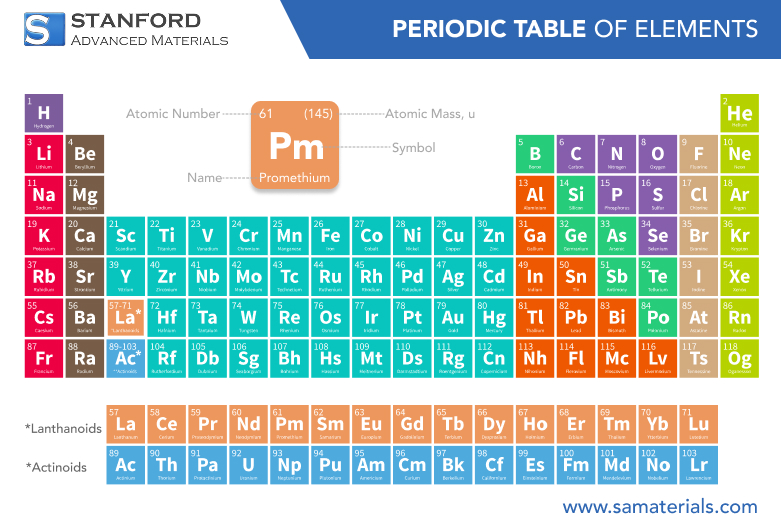
Overview of Promethium
Promethium was first identified in 1945 by American scientists Jacob A. Marinsky, Lawrence E. Glendenin, and Charles D. Coryell, following the discovery of its radioactive isotopes. The element was named after Prometheus, a figure in Greek mythology who stole fire from the gods and gave it to humans, symbolizing the element's association with energy and radioactivity.
Promethium is unique among the lanthanides in that it has no stable isotopes, making it entirely radioactive. Its most stable isotope, Pm-145, has a half-life of 17.7 years. However, due to its scarcity and the fact that it is not naturally abundant, it is primarily produced synthetically in laboratories or nuclear reactors.
Physical and Chemical Properties
Promethium is a silvery-white metal that is quite soft and has properties similar to other lanthanides like samarium and neodymium. It is often classified as an alkaline earth metal due to its chemistry, though it is technically a member of the rare-earth elements.
- Atomic Number: 61
- Melting Point: 1,042°C (1,908°F)
- Boiling Point: 3,000°C (5,432°F)
- Density: 7.26 g/cm³ (at 20°C)
Promethium exhibits a high melting point for a lanthanide element and shows moderate solubility in water due to the formation of various compounds like promethium hydroxide. As with many lanthanides, it has high electrical conductivity, though it does not form as many useful alloys as some other rare-earth elements.
Radioactivity and Isotopes
The key feature of promethium is its radioactive nature, which defines much of its application and behavior. There are over 30 isotopes of promethium, but none are stable. The most well-known and studied isotopes are:
- Pm-145: The most stable isotope with a half-life of 17.7 years, used in research.
- Pm-147: One of the most widely produced isotopes, with a half-life of 2.62 years, used in various applications.
- Pm-146: Another isotope with notable usage in scientific contexts.
Promethium isotopes decay by beta emission, releasing high-energy electrons and turning into stable elements such as samarium. Due to this radioactive decay, promethium emits a significant amount of heat, which can be harnessed for various uses, especially in battery technology and heat sources.
Production of Promethium
Since promethium is not naturally abundant, it is typically produced artificially in nuclear reactors or particle accelerators. The most common method involves bombarding uranium or neodymium with neutrons in a nuclear reactor, creating promethium isotopes through neutron capture reactions. These reactions can yield small quantities of promethium, which is then isolated and purified for specific applications.
Promethium is also sometimes found as a byproduct of the uranium refining process, though this is not a significant source, and the amounts recovered are minimal.
Uses of Promethium
Although promethium is not widely used on a day-to-day basis, its unique radioactive properties give it important applications in energy production, lighting, and scientific research.
1. Nuclear Batteries
One of the most notable applications of promethium is in nuclear batteries, particularly radioisotope thermoelectric generators (RTGs). In these devices, the heat produced by the radioactive decay of isotopes like Pm-147 is converted into electrical energy through thermocouples. These batteries are small, long-lasting, and provide reliable power without needing recharging, which makes them ideal for use in space exploration and remote sensing.
2. Luminous Paints and Dials
Promethium-147 is used in certain luminous paint formulations that can glow without an external light source. By emitting beta radiation, promethium isotopes excite phosphors in the paint, causing it to emit light. This makes it useful in applications like luminous dials, watch hands, and instrumentation panels where a steady, low-level glow is necessary for visibility in the dark.
3. Heat Sources for Space and Medical Applications
Because promethium isotopes emit heat as a byproduct of radioactive decay, they can be used as portable heat sources in remote locations. Promethium-147 has been employed in medical devices for targeted heat applications, such as in thermal probes for internal body monitoring or for heat therapy in specific treatments. This is a niche but important use of the element.
4. Scientific Research
Promethium has a role in scientific research, particularly in nuclear physics and material science. Because of its radioactivity, it is used in tracer studies and experiments involving nuclear decay processes. Researchers can track how promethium isotopes behave in different environments and measure radiation levels, providing insights into atomic structures and the behavior of radioactive materials.
Health and Safety Concerns
Given its radioactivity, promethium must be handled with care, and its use is regulated to minimize radiation exposure. In large quantities, exposure to promethium and its radioactive isotopes can pose health risks such as radiation sickness, cancer, or organ damage. Special precautions are required for those working with promethium, and it is generally contained within sealed devices or storage units to prevent accidental exposure.
Conclusion
Promethium may be a rare and radioactive element, but its unique properties give it a valuable role in various high-tech industries. Whether used in space exploration, nuclear power sources, or scientific research, promethium continues to provide essential functionality in niche applications. Its discovery in the mid-20th century opened up new possibilities for harnessing radioactive decay, and its controlled use remains important in fields where stable, long-lasting energy is required in remote or extreme environments. As technologies evolve, promethium may find even more applications, cementing its place in the pantheon of rare but critical elements.




 Chin Trento