
 Products
 Bars
Bars
 Beads & Spheres
 Bolts & Nuts
 Crucibles
 Discs
Discs
 Fibers & Fabrics
 Films
Films
 Flake
Flake
 Foams
Foams
 Foil
Foil
 Granules
 Honeycombs
 Ink
Ink
 Laminate
 Lumps
Lumps
 Meshes
 Metallised Film
 Plate
Plate
 Powders
 Rod
Rod
 Sheets
 Single Crystals
 Sputtering Target
 Tubes
Tubes
 Washer
 Wires
Wires
 Converters & Calculators
 Write for Us



Polonium: Element Properties, Uses, History, and Safety
Description
Polonium is a rare and highly radioactive element. Applications include thermoelectric power generation, the removal of static electricity, and biomedical research. Safety concerns limit its use, however.
History and Production
The discovery of polonium by the Curies was an important milestone in the research of radioactivity and nuclear chemistry. It was isolated from uranium ores using chemical methods, and its radioactivity quickly became a defining characteristic. Over time, scientists have learned to harness polonium's unique properties, although the rarity and radioactive nature have created complications with its production.
The primary method for producing polonium is typically by neutron irradiation of bismuth targets in a nuclear reactor. Such neutron irradiation transforms the bismuth into one of the most common isotopes of polonium: polonium-210. In extracting and purifying polonium, there are many complex, elaborate chemical separations because of its low natural abundance and the presence of other by-products. Therefore, it remains an element with very limited production and at a highly valued cost because the process of production is quite complicated.
Chemical Properties Description
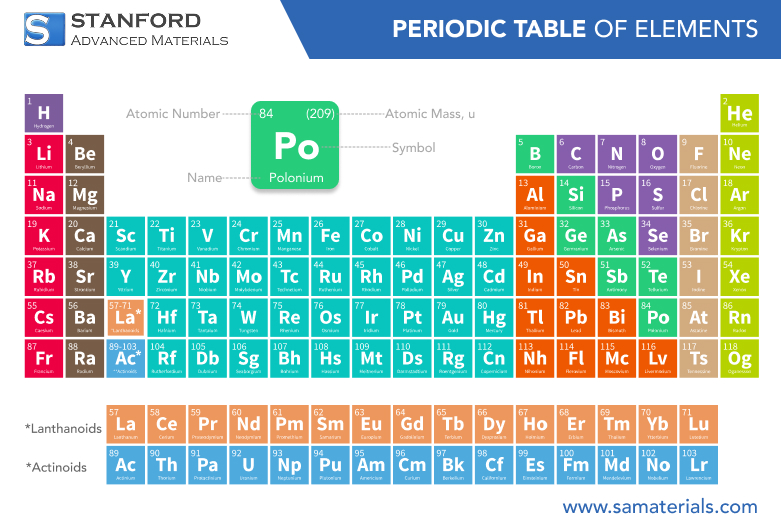
Polonium is a radioactive, metallic element belonging to the group of chalcogens with atomic number 84. It commonly assumes the +2 oxidation state, though it can also take up a +4 state if the conditions so permit. These oxidation states allow polonium to form various compounds with metals and nonmetals, including chalcogenides and halides, which are of interest in nuclear chemistry.
Radioactivity leads to self-heating of polonium, which can affect the kinetics of chemical reactions. Such self-heating properties are among the many reasons polonium is studied under highly controlled laboratory conditions. The compounds of polonium are less stable compared to the compounds of lighter elements of the chalcogen group, which furthers the complexity in working with it.
Physical Properties
Property | Value | Unit |
Atomic Number | 84 | - |
Atomic Weight | 209 | amu |
Density | 9.2 | g/cm³ |
Melting Point | 254 | °C |
Boiling Point | 962 | °C |
For more information, please check Stanford Advanced Materials (SAM).
Thermal and Electrical Properties
The thermal and electrical properties of polonium take into account its radioactive nature. It is an effective emitter of heat, which finds application in thermoelectric uses, including space missions. Its alpha radiation emanation is part of its key importance in a few specialized industrial and scientific uses. However, due to its radioactivity, it does not find widespread applications within electrical circuits, because it can interfere with the operation of other components and also creates significant safety risks.
Uses of Polonium
Few applications of polonium exist industrially, scientifically, and biomedically, in spite of its radioactivity and rarity. Here are a number of notable uses:
1. Static Electricity Removing
It is applied in brushes and other devices to remove static charge from materials like photographic film and in textile mills. The alpha particles emitted by polonium have been quite effective in neutralizing the static charges, hence preventing dust and particle accumulation on sensitive materials.
2. Thermoelectric Power for Space Equipment
The isotope of polonium, polonium-210, serves as a heat source in thermoelectric generators, especially in space satellites. In the cold vacuum of space, polonium's radioactive decay provides a steady supply of thermal energy, which helps keep electrical equipment warm and functional. It is especially useful in deep-space missions where solar power is not as effective.
3. Biomedical Research
Po-210 has been used in some biomedical research due to its potent alpha emission. While its use is limited in basic research because of safety concerns, studies involving radiotherapy and other medical applications are some areas where this isotope has been utilized. Its radioactive properties provide value for certain targeted treatments; however, handling risks mean that its use is highly controlled.
4. Nuclear Batteries
Polonium-210 has been considered for use in nuclear batteries, which are used in some remote or long-duration applications, such as in pacemakers or spacecraft. Its alpha radiation provides a consistent energy source over a long period, though safety concerns limit its widespread use.
Safety and Risks
Polonium is highly dangerous because of its high level of radioactivity, especially the alpha radiation that it emits. Alpha particles cannot penetrate through the skin but can cause serious damage if polonium is swallowed or taken into the body by inhalation. Exposure to even small amounts of polonium-210 is actually lethal.
Handling polonium requires specialized equipment and precautions. Laboratories working with polonium should have shielded enclosures, and the personnel involved in such procedures have to wear protective gear that prevents contamination. Moreover, radioactive material must be disposed of and contained by strict protocols in order not to contaminate the environment.
The tragic demonstration of the risks associated with the application of polonium came with the poisoning of former Russian spy Alexander Litvinenko in 2006, in which polonium-210 was administered as a poison. It brought global attention to the dangerous nature of this element and the care needed in handling it.
Frequently Asked Questions
1. What is polonium and where was it discovered?
Polonium is an intensely radioactive element discovered in 1898 by Marie and Pierre Curie. The name is derived from Poland, the native country of Marie Curie.
2. How is polonium produced?
Polonium is made by exposing bismuth targets to neutrons in a nuclear reactor. This converts the bismuth into polonium-210. Complex chemical separation techniques then yield the element.
3. What are the main applications of polonium?
Applications involving polonium include static eliminators, a heat source in space applications, nuclear batteries and biomedical applications that take advantage of its alpha radiation.
4. Why is polonium dangerous?
Because of its high radioactivity, polonium is highly toxic. Alpha radiation from polonium is very destructive to biological tissue when ingested or inhaled.
5. What safety precautions are needed when handling polonium?
Since polonium is a radioactive element, it should be treated with great caution. Special equipment, shielded laboratories, and strict safety protocols are necessary to avoid contamination and harm to workers.




 Chin Trento